
Putnam County Parole and Probation
Parole and probation are not two names for the same status. Probation is imposed by a court, often instead of a jail or prison term or after a short custodial term. The Putnam County sentencing order states the length and conditions. The Marshall-Putnam-Stark probation district administers that order locally. Illinois prison release is different. Most modern determinate prison sentences use mandatory supervised release, often shortened to MSR, rather than discretionary parole. IDOC's Parole Division supervises people in the community, while the Illinois Prisoner Review Board handles duties that include conditions, revocations, and certain release proceedings.
A person may leave Putnam County Jail with no probation. Another person may finish jail time and start probation. Someone transferred from the jail to IDOC has not entered community supervision at all. Read the legal authority rather than guessing from a custody change.
| Record type | Who orders it | Who handles it | Best proof |
|---|---|---|---|
| Probation | Putnam County court | Shared county probation district | Sentencing and termination orders |
| MSR or parole | Illinois law and applicable PRB action | IDOC Parole Division | IDOC profile and agency record |
| Pretrial release | Trial court | Court and pretrial services | Current court order |
| Complete discharge | Depends on sentence | Court or IDOC | Discharge or termination record |
- MSR
- Mandatory supervised release, a period of state supervision after prison.
- Probation
- A court sentence served under local supervision and stated conditions.
- Discharge
- The end of a specified custody or supervision term, as shown by its source record.
- Absconder
- A person alleged to have stopped complying or whose location is unknown to supervision staff.
Verify Putnam County Release Supervision
Start with the sentence source. IDOC's live search is useful for a person still in prison or on parole, but it is not a complete county probation index. A live state profile may show a `PAROLE` status, a parole-district location, an actual Parole Date, and a future projected discharge date. Those fields indicate prison exit into continuing state control. Fully completed IDOC sentences normally leave the public live search, so an absent profile does not prove that no state sentence or supervision existed.
- Match the full legal name and, when possible, the court case or IDOC number.
- For a state sentence, search the IDOC Individual in Custody Search. Read status, location, and actual dates together.
- For probation, inspect the Putnam County sentencing order and later docket entries. Obtain the signed order if a short docket code is unclear.
- Contact the correct office. County probation cannot confirm an IDOC parole schedule, and the sheriff does not administer either program.
- Look for a termination or discharge entry before treating supervision as complete.
The Putnam County released-inmate search routes help locate the court, sheriff, and IDOC records that establish the custody path. Use the originating office for a final status check.
Putnam County Probation Contact
Putnam County probation belongs to a shared Marshall-Putnam-Stark district. The local contact works at the courthouse in Hennepin. This office is the right starting point for a probation term entered in a Putnam County case. It is not an IDOC parole field office and cannot turn a state prison profile into a county probation record.
Putnam County Probation
Samuel Wier
120 N. Fourth St.
Hennepin, IL 61327
Phone: 815-925-7153
Fax: 815-925-7267
Email: pcprobation@putnamil.gov
Ask about the office's public verification process and current contact routing. A person's residence, meeting schedule, and safety-sensitive details may not be public. The court file remains the durable source for the sentence itself.
Putnam Supervision Violations and Warrants
Conditions vary by sentence and order. They may govern reporting, travel, treatment, payment, or conduct, but no general web summary proves the terms for one person. Read the signed court order for probation and the controlling IDOC or PRB record for state supervision. A missed appointment should not be inferred from an old profile or rumor.
An absconder label is an allegation within the supervision process, not a normal release status. Verify any warrant through official court or law-enforcement records. Putnam County publishes no online absconder list. PRB publishes monthly final-revocation result PDFs for proceedings in its jurisdiction, but those files are not a complete name-search database for everyone under MSR. A hearing date is also not a final action.
Note: A custody alert may signal a change, but the court or supervising agency explains its legal effect.
Putnam County Supervision Discharge
Supervision ends through a record, not merely through the passage of an expected date. County probation completion may appear as a discharge or termination order in the Putnam case. A future IDOC projected discharge date is a planning milestone. It does not prove that the sentence has ended. A final state status may require IDOC's archived Record Search because completed sentences ordinarily stop appearing in the live locator.
The word discharge must be read in context. It can mean the end of one agency's control or the end of the whole sentence. Other cases, warrants, or a separate supervision term may remain. When the public profile no longer appears, use IDOC's contact page and choose Record Search. Supply the full name, birth date, year received, and known facility, conviction county, or dates. The court judgment remains useful for checking the imposed term.
Putnam Release Property Records
Putnam's inspected jail procedure creates a useful local paper trail before a person leaves county custody. Inventoried property must be returned, and an itemized receipt signed by the person is retained permanently. The process also records maintenance medication supplied at release. These are separate from parole or probation, yet they can help confirm that jail discharge processing occurred and resolve a later property question.
A targeted sheriff FOIA request may seek the existing property receipt or medication-supply record tied to a specified booking and release, subject to lawful redaction. Do not ask the sheriff to create a new explanation. Ask for the maintained record, identify the person and approximate dates, and request electronic copies when available. The receipt proves a release-processing step, not the absence of later state or local supervision.
Illinois Release Hearing Records
The Prisoner Review Board's calendar is relevant only to proceedings within the board's authority. Illinois modern determinate sentencing means that not every prison exit follows a discretionary parole grant. Legacy indeterminate sentences and specified matters may receive release review, while the board also handles MSR conditions and revocations. Calendar listings are commonly organized by month, institution, or hearing type rather than Putnam County.
Use the official PRB hearing hub to identify the calendar type, month, institution, and publication date. Then consult the dated result or decision material when it is published. Quote the exact action. Grant, deny, continue, impose conditions, or revoke can have distinct meanings, and a scheduled hearing alone proves none of them.
The available manifest image shows the local probation contact page, which is the correct source for a Putnam County probation sentence:
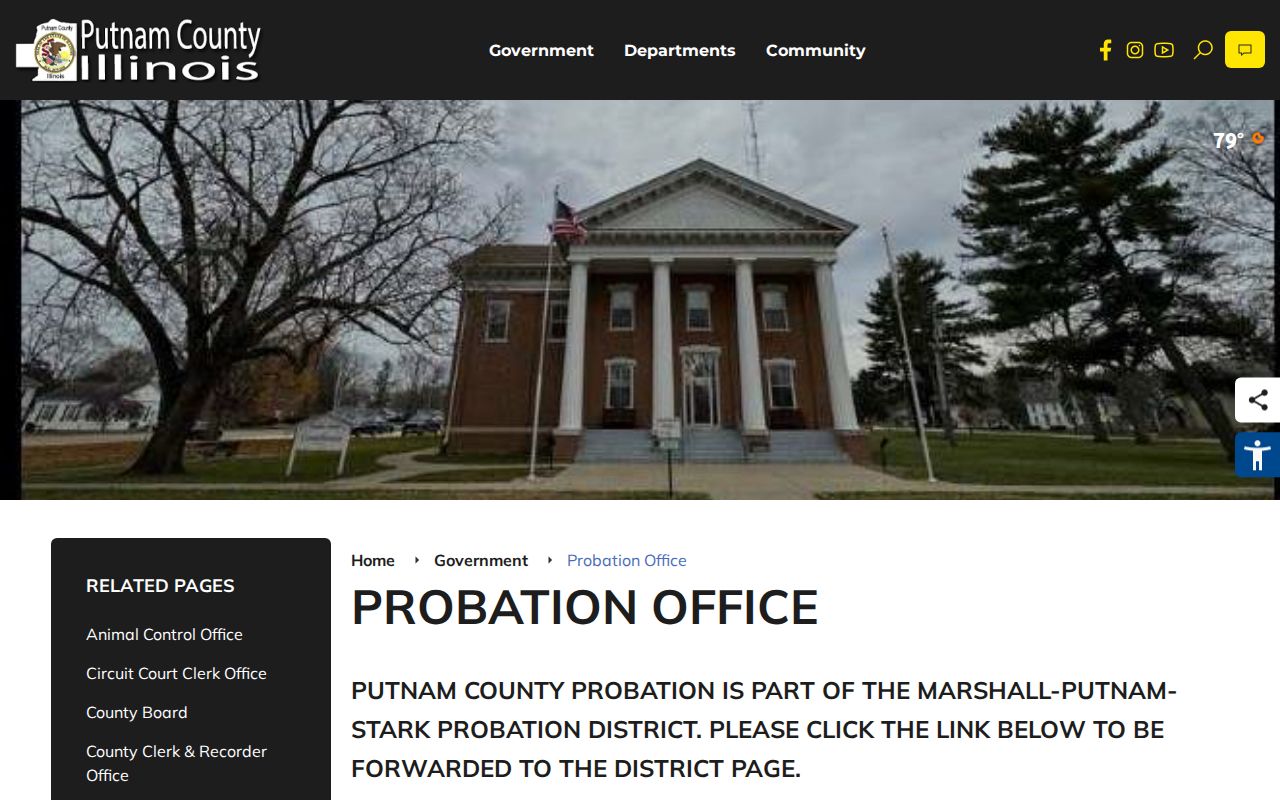
The office details on that source distinguish local court probation from state IDOC parole supervision.
Putnam Supervision Evidence
Verification is strongest when the records form a timeline. Start with the Putnam judgment to identify whether the sentence includes probation, conditional discharge, commitment to IDOC, or another term. Then check later docket entries for a violation, warrant, amendment, termination, or discharge. A short docket code may not reveal the conditions or result, so request the signed order when the distinction matters.
For state custody, record the exact status and location in the IDOC profile. `PAROLE` and a parole-district location point to community supervision, while an institution location indicates custody. A future Projected Discharge Date does not prove supervision has ended. Fully completed IDOC records may require archived Record Search because they ordinarily disappear from the live locator.
Illinois VINE can add a timely custody or court alert, but the reporting agency controls its meaning. Follow a county release alert with the sheriff and court. Follow an IDOC event with the state profile and Parole Division. If the event says transfer, identify the receiving custodian rather than describing the person as free.
Putnam Supervision Record Boundaries
Public records do not expose every detail of supervision. A person's home address, check-in schedule, treatment information, and safety-sensitive facts may be restricted. Ask the supervising office for the public verification it can provide and use the court or IDOC record for the legal status. Silence from a public page does not show compliance or violation.
The PRB calendar also has limits. It is organized by proceeding type, institution, and date, not as a Putnam County list of all people on MSR. A scheduled hearing is not a grant, denial, or revocation. Consult the dated decision or result material and quote its exact action. Modern Illinois prison releases do not all depend on a discretionary parole grant.
Registries maintained by Illinois State Police are narrower still. They list only qualifying registrants under their governing laws. A registry entry is not a complete parole, probation, or criminal-case record. Match each source to the single fact it can prove.